
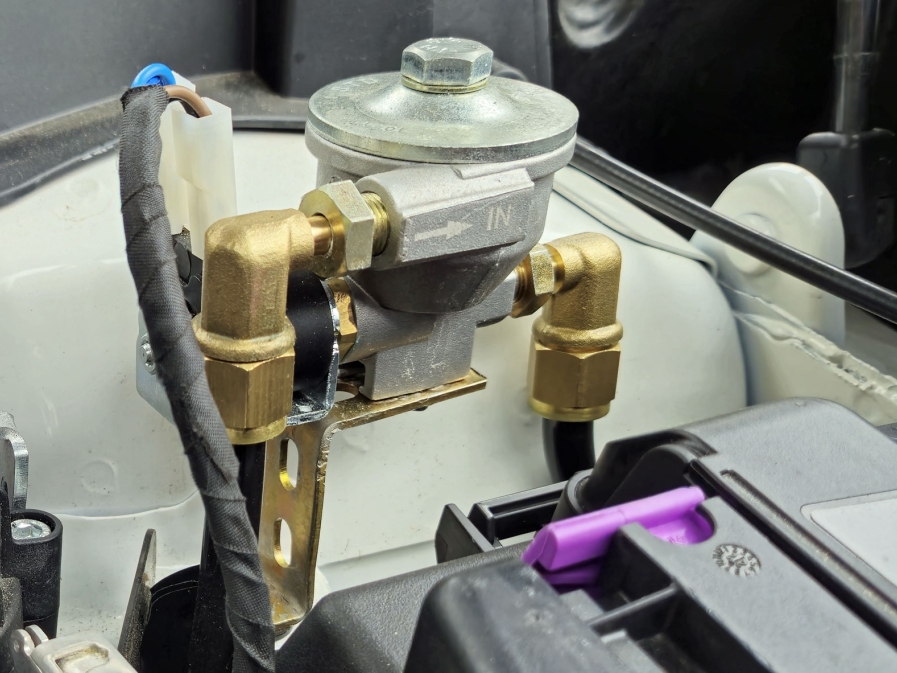
What is an LPG solenoid valve and what is its function?
An LPG gas solenoid valve in a car is an electrically controlled component whose operation is automatic and takes place without the driver’s involvement. The task of an LPG solenoid valve is to control the flow of liquefied gas, i.e. the opening and closing of the supply of liquid-phase LPG from the tank to subsequent components of the automotive gas installation, regardless of its generation.
Opening the gas solenoid valve requires supplying voltage to the terminals of the coil that controls the plunger, i.e. the element that opens and closes the LPG flow. In the closed position, the plunger is pressed against the seat by a spring.
Starting the engine and, after some time – among other things after the coolant in the cooling system reaches the appropriate temperature – switching to LPG is the result of the operation of the gas system controller. Once the required parameters are detected, it supplies voltage to the gas solenoid valve coil, the valve opens, and LPG flows to further components of the gas system, namely to the reducer and then to the injector rail.
Gas solenoid valves, including Lovato solenoid valves, in addition to controlling fuel flow, also secure the LPG system. When the engine stops running without the driver’s intention (as a result of a failure or, for example, a road collision), the automotive gas system is switched off and the solenoid valves are closed, which prevents LPG leakage.
Gas solenoid valves should be installed as close to the reducer/vaporizer as possible.
Types of LPG solenoid valves
Gas solenoid valves are most often equipped with liquid-phase LPG filters, although a few models without a filter are also available. Often, the gas solenoid valve together with the filter is integrated with the reducer-vaporizer, forming a compact and therefore easy-to-install unit.
Gas solenoid valves also differ in size, i.e. in the amount of liquid-phase LPG that can flow through them. In addition to standard-size gas solenoid valves, to which LPG flows from the tank through a line with a diameter of 6 mm (the outlet fitting is the same size), larger solenoid valves with higher flow capacity (often referred to as BFC – Big Flow Capacity) are also available. These work with high-pressure LPG lines with a diameter of 8 mm and are intended for gas systems supplying larger engines with greater displacement and power.
Solenoid valves with a liquid-phase LPG filter
Solenoid valves with a liquid-phase LPG filter (e.g. Landi Renzo solenoid valves) are most commonly used in automotive gas systems. Their advantage is the possibility of installation in an easily accessible location, which facilitates later servicing, including replacement of the liquid-phase LPG filter element.
Reducers integrated with a solenoid valve and liquid-phase filter
From an installation point of view, reducer-vaporizers built as units integrated with gas solenoid valves are very convenient. If the installation location is easily accessible, later servicing of the system, during which the liquid-phase LPG filter element is replaced, is very easy. It is worse if there is little space in the engine bay and the reducer integrated with the solenoid valve must be installed in a location with much poorer accessibility. In that case, replacing the liquid-phase LPG filter element may be somewhat more difficult.
Gas solenoid valves without a liquid-phase LPG filter
Gas solenoid valves without a liquid-phase LPG filter are used much less frequently. Their use requires installing a liquid-phase LPG filter in a separate housing, which may even be an advantage of such a solution, because the solenoid valve itself can be installed as close to the reducer as possible, and the filter in an easily accessible place, facilitating later replacement of the filter element.
Differences between individual types and their application
In terms of design, all the listed gas solenoid valves are very similar to each other. They are plunger-type solenoid valves held in the closed position (when switched off or when voltage is lost) by a spring. All types of gas solenoid valves are used in automotive gas systems. Each of the listed solutions can be used interchangeably depending on the preferences of the driver or the installing and servicing workshop, as well as with regard to installation considerations (available space and accessibility) in a specific vehicle model.
Compatibility of LPG solenoid valves
LPG solenoid valves used in automotive gas systems are selected according to the size of the engine units in which they are to be used.
How to check compatibility with the type of LPG system
The gas solenoid valve (its size) must be selected with regard to the size of the connection fittings, which must work with the high-pressure lines used in a given vehicle. These lines may have a diameter of 6 or 8 mm (for larger and more powerful engines) and are a result of the size and parameters of the engine unit.
The most common mistakes when choosing
The most common mistakes include choosing a solenoid valve with too low a flow capacity, i.e. with connection fittings designed to work with 6 mm lines instead of 8 mm. This may limit the amount of LPG supplied to the engine, which translates into reduced engine parameters and thus poorer vehicle performance.
What to pay attention to when buying
The gas solenoid valve should be selected according to the parameters of the engine unit (its power). When replacing a solenoid valve with a new one, it is best to use the same model. If, for some reason, this is not possible, it must be selected appropriately for the size and parameters of the engine unit (in terms of flow capacity), i.e. with suitable connection fittings adapted to work with the fuel lines used in the vehicle.
Materials and build quality
The bodies of LPG solenoid valves are most often made of brass or aluminum alloys, with which an electromagnetic coil cooperates, moving the plunger that opens or closes the flow of liquid-phase LPG.
Technical parameters (e.g. operating pressure, flow rate)
A shop offering LPG system components will certainly advise what to pay attention to when purchasing a gas solenoid valve. Among the parameters worth reviewing are maximum operating pressure, permissible temperature range, and gas flow rate. These parameters must be adapted to the engine power and the characteristics of the LPG system in order to ensure stable operation under all conditions.
Certifications and safety standards
LPG solenoid valves are components subject to the homologation process according to Regulation No. 67, which guarantees that they meet European safety standards and can be legally used in automotive LPG systems installed in vehicles driven on public roads.