
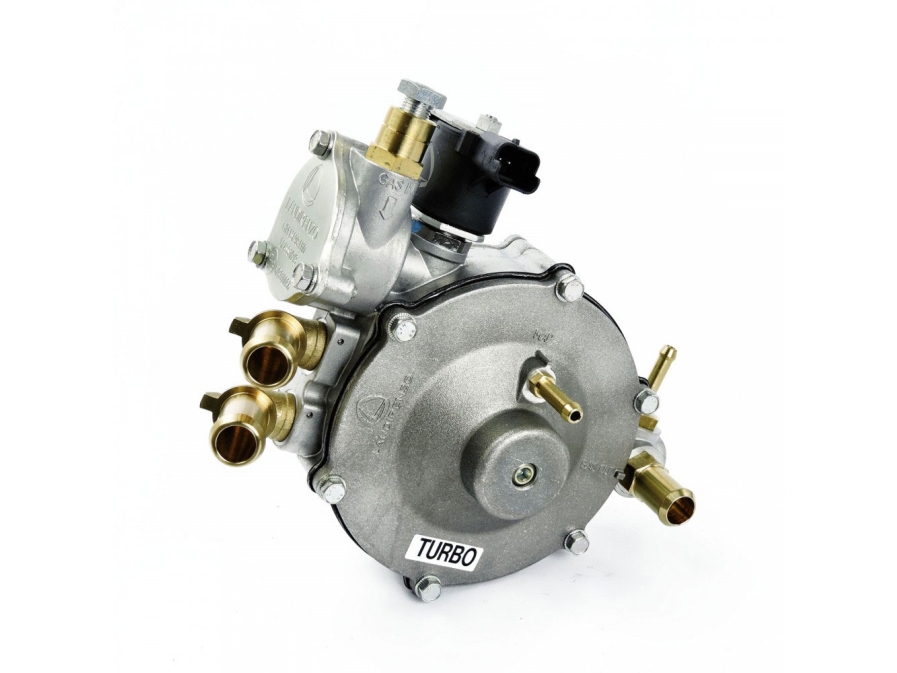
What is an LPG reducer? (design, main components)
An LPG gas reducer, more precisely an LPG reducer–vaporizer, is a device in which liquefied petroleum gas (LPG) changes its state from liquid to gaseous and is maintained at an appropriate pressure.
The change of LPG from the liquid phase to the gaseous phase takes place in the part of the reducer called the vaporizer. To intensify the phase change of the liquid propane–butane mixture, the vaporizer section of the reducer is equipped with a water jacket through which coolant from the engine’s cooling system flows. The coolant is supplied to the reducer via flexible rubber hoses connected to fittings mounted in the housing, most often swivel elbows.
The vaporized LPG is maintained at the appropriate pressure by means of a diaphragm supported by a spring with tension adjustable via a screw, which allows regulation of the LPG vapor-phase pressure at the outlet of the reducer. On the opposite side of the diaphragm there is a lever connected to a valve that controls the inflow of LPG from the tank into the reducer–vaporizer.
The vast majority of reducer–vaporizers used in fourth-generation gas fuel systems (sequential vapor-phase gas injection, including engines with direct gasoline injection) are single-stage, diaphragm-type devices.
How does an LPG reducer work?
The reducer–vaporizer, regardless of whether it is a Lovato, BRC, or Landi Renzo reducer, is a device in which LPG stored in the tank in liquid form is prepared for delivery to the engine intake system, i.e., converted into the vapor (gaseous) phase.
The gas pressure reduction process
Liquid-phase LPG, supplied at the pressure present in the tank, flows through a valve into the vaporizer chamber heated by heat delivered via coolant from the engine cooling system. This chamber is equipped with a diaphragm supported by a spring with adjustable tension. In the vaporizer chamber, LPG evaporates (changes from the liquid phase to the gaseous phase). As the LPG vaporizes, its volume increases, causing the diaphragm to move. Thanks to its connection to the valve (via a lever), this movement closes the supply of liquid LPG to the vaporizer. When vapor-phase LPG is drawn from the reducer–vaporizer and delivered via injectors to the engine intake ports, the pressure drops, the diaphragm returns, and the inflow of liquid-phase LPG from the tank into the vaporizer opens again. The entire cycle then repeats.
Regulation of gas flow to the engine
In an engine adapted for LPG operation using a fourth-generation automotive gas system (sequential vapor-phase gas injection) equipped with a single-stage diaphragm reducer, regulation of gas flow to the engine is handled by gas injectors. These injectors meter the fuel doses (LPG vapor phase) calculated by the gas control unit into the intake ports of individual cylinders.
The role of the reducer in ensuring safety
Reducer–vaporizers are equipped with PRV (Pressure Relief Valve) safety valves that protect them against excessive pressure increase. Their outlets, in the form of fittings, should be connected with a flexible rubber hose to the engine intake system. In addition, if the gas fuel system becomes depressurized, all gas solenoid valves and LPG injectors in the installation are automatically closed, preventing any possibility of fuel leakage.
Typical problems with LPG reducers
LPG reducers are generally durable devices capable of withstanding high mileage. However, their gradual wear eventually leads to improper operation of the gas fuel system.
Symptoms of a faulty reducer
Symptoms of improper operation of a reducer–vaporizer may include, among others:
- irregular engine operation,
- difficulty starting the engine,
- jerking while driving,
- engine stalling at idle,
- problems when switching the engine supply from gasoline to LPG.
Common faults
Faults occurring in reducer–vaporizers result mainly from operational wear, aging of rubber and plastic components, and the accumulation of contaminants inside the unit. This is most often caused by neglecting regular replacement of the liquid-phase LPG filter.
LPG reducer faults may manifest themselves, among others, as:
- leaks in the gas section,
- leaks in the water (coolant) section,
- wear or hardening of the diaphragm,
- damage to the housing.
Impact of a faulty reducer on vehicle operation
A faulty reducer–vaporizer causes problems with driving on gas, as the power unit exhibits the issues listed above.
Maintenance and replacement of the reducer
The reducer–vaporizer used in gas fuel systems, regardless of whether it is a Lovato, BRC, or Landi Renzo reducer, does not require any special maintenance procedures beyond those resulting from standard inspections of the automotive gas installation. Nevertheless, after a certain mileage (from several tens of thousands to well over 100,000 km), the reducer requires repair or replacement with a new one.
How to take care of an LPG reducer?
For the reducer–vaporizer to operate correctly over a long period of use, the liquid-phase filter insert should be replaced regularly in accordance with the requirements of the gas system manufacturer. This filter protects the interior of the reducer from contaminants that may enter with the LPG.
Attention should also be paid to the quality of the refueled LPG, which is generally ensured by large fuel station networks.
It is also important to maintain the correct coolant level in the engine cooling system. This ensures that the reducer’s water jacket is always filled and that the unit achieves full efficiency.
When should the reducer be replaced?
If the reducer is not suitable for repair—i.e., its mechanical components show significant wear and the use of a repair kit (which usually includes all wear parts) does not restore full functionality—it should be replaced with a new one. The condition of the reducer can be assessed after disassembly, but a precise evaluation requires workshop-level knowledge and experience.
Guidelines for choosing an appropriate replacement model
From the user’s perspective, the best solution is to replace the reducer, preferably with the same model, as this eliminates the need to modify the mounting. During such a replacement, it is also advisable to replace the gas and coolant hoses, as they wear over time, become less flexible, and may be difficult or even impossible to seal properly on the reducer fittings.
If, for some reason, the reducer must be replaced with a different model, the key selection criterion is capacity—i.e., the ability to vaporize an amount of LPG sufficient to meet the fuel demand of engines with a given power output.
The new reducer, regardless of whether it is a Lovato, BRC, or Landi Renzo model, must also fit into the existing installation space and therefore should have similar dimensions. The diameter of the reducer fittings is also important; they must match the gas and coolant hoses. Additionally, the diameter of the liquid-phase LPG supply fitting (6 or 8 mm, depending on the line used) must be correctly selected.
As can be seen, there are many aspects to consider before repairing a reducer or replacing it with a new one. Therefore, it is best to entrust such work to a reputable workshop specializing in the installation and servicing of automotive gas systems, which can assess all these factors and offer the most appropriate solution.