
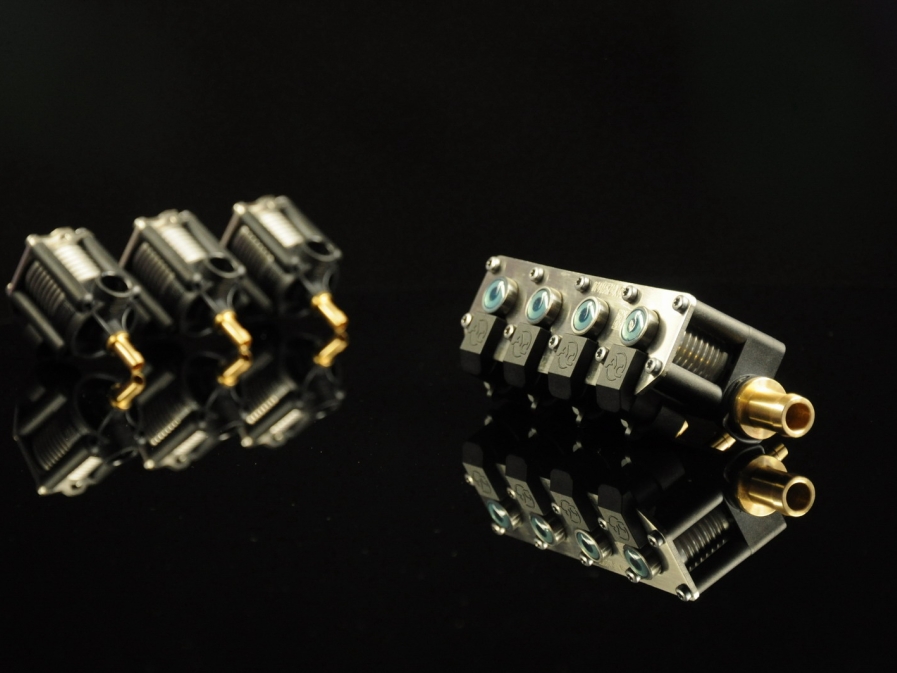
Function of LPG injectors
The gas injector rail or LPG injector rail consists of components responsible for metering doses of LPG in the gaseous phase, calculated by the LPG controller, into the intake ports of engines adapted for autogas operation using fourth-generation automotive gas systems (sequential gaseous-phase gas injection).
Injector rail or LPG injection rail?
The gas injector rail and the LPG injection rail are colloquially the same components responsible for supplying LPG to the engine intake ports. However, a distinction can be made between these two terms. A gas injector rail can be defined as an assembly composed of individual LPG injectors mounted in a dedicated rail (housing), forming a rail. Once removed from such a rail (housing), the injectors can operate independently as single gas injectors.
In contrast, an LPG injection rail is a single, compact unit with a common housing. Although it is possible to remove the injectors or the pumping sections themselves, they are not capable of operating independently.
Gas injector rail – a precision component
Due to the precision required for accurately metering gaseous fuel doses, LPG injectors and injector rails are manufactured with a high degree of accuracy. They can be considered the most precise components of automotive gas systems, as the correct operation of the gas installation in a vehicle depends directly on their precision.
Types of gas injectors
The classification of gas injectors based on the flow-controlling elements used within them (their shape) is somewhat conventional and reflects colloquial terms used in workshop jargon. Depending on the shape and type of the gas flow control element, gas injectors can be divided into:
- diaphragm injectors – the gas flow is controlled by a lightweight, flexible diaphragm, which results in very fast operation,
- plate (reed) injectors – the gas flow is controlled by a light metal plate, making these injectors relatively fast,
- piston injectors – the element opening and closing the gas flow is a metal piston whose mass is significantly higher than in the above solutions.
Currently, most gas injectors are piston-type designs, which can additionally be divided according to the method of supplying the gaseous LPG phase into:
- top-fed,
- bottom-fed.
Operating principle of gas injectors
Since most gas injectors used today are piston-type injectors, and piston sections are also used in injection rails, their operating principle is similar to that of gasoline injectors. An electromagnet (electromagnetic coil), by generating an electromagnetic field, moves the element that opens the gas flow into the intake ports. In the closed position, the injector is held by a spring that presses the piston controlling the gas flow against the seat inside the injector. The differences compared to gasoline injectors result from the physical state of the fuel. Gaseous LPG has a much larger volume compared to the corresponding dose of gasoline. Therefore, LPG injectors have significantly larger flow channel cross-sections than gasoline injectors. The pistons also have larger diameters, which translates into greater mass and, consequently, higher inertia. This necessitates the use of electromagnetic coils capable of generating high forces, sufficient to move the relatively heavy pistons at the required speed.
Selection of injectors and injection rails for an engine
Gas injectors, as well as LPG injection rails with appropriate flow capacity, are selected for specific engines based on engine power. Injector and gas rail manufacturers specify their capacity in horsepower per cylinder (HP/cyl.). By dividing the engine power by the number of cylinders, a parameter is obtained that is used to select the appropriate gas injectors for a given engine.