
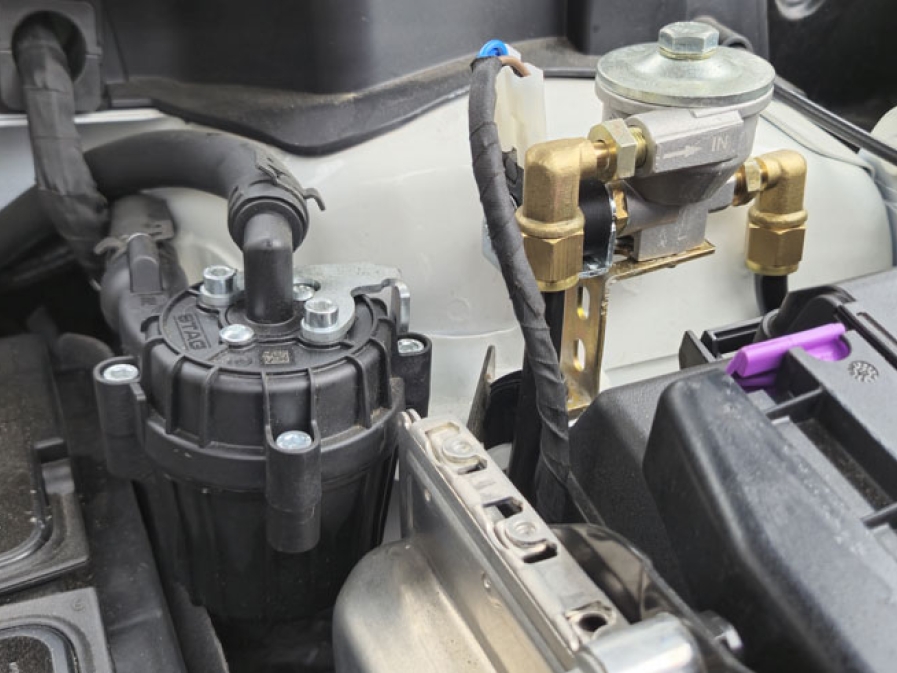
Seemingly a simple operation
Replacing LPG filters in a vehicle’s autogas system may appear to be a simple task. For this reason, many people unfortunately try to perform it themselves.
However, these activities require substantial knowledge about LPG as a fuel, its behaviour, and experience in carrying out such operations, because any mistake can lead to serious consequences.
High overpressure
LPG is stored in the tank under significant overpressure, as only such conditions keep it in a liquid state. Any uncontrolled leakage of the gas installation can lead to a potentially dangerous, sudden release of LPG. The intensity of this process results from the overpressure under which LPG is stored and from the rapid phase change that occurs during such a release.
Rapid change of physical state
The release of LPG in liquid form results in its rapid evaporation in the air (a change of state from liquid to gas). During this process, a gaseous phase is created, whose volume is approximately 250 to 270 times greater than that of liquid LPG. This significantly increases the intensity of the release from the high-pressure part of the gas installation, where LPG remains in liquid state.
A large amount of heat – frost formation
It is also important to understand that this phase change—from liquid LPG to gaseous LPG—requires a significant amount of heat. When LPG escapes to the outside, that heat is absorbed from the surrounding air and from the components from which the liquid gas is leaking. Due to rapid evaporation, their temperature drops quickly, moisture from the air condenses on them, and then freezes, forming a layer of frost. Because of this phenomenon, contact of body parts with escaping LPG can result in severe frostbite. This is one of the reasons why DIY replacement of LPG filters is not recommended.
A flammable mixture
Additionally, the gaseous phase of LPG is highly flammable. When it is produced intensively due to LPG leakage, it creates a serious fire hazard—and even an explosion risk—if gaseous LPG accumulates in an enclosed space.
Filter replacement is not everything
It is also important to understand that replacing LPG filters is not the only procedure performed as part of the inspection of a vehicle’s autogas system. Many additional tasks are carried out to maintain the gas system in proper condition so that it doses fuel correctly and provides the right gas-air mixture for proper engine operation. The system’s tightness is checked—also after the filter replacement, which requires opening the gas circuit. Technicians also inspect mounting points, the quality of electrical, gas and coolant connections, and perform many other tasks that directly or indirectly influence the functioning of the autogas system.